« This issue stands under the trees. A Roman poet completes, around 29 before our era, the fourth book of a farming poem which is also the oldest treatise on beekeeping we still read: he is wrong about almost everything he is most certain of, and right about shelter, smoke and the two harvests. The house then says why it still writes to you in English, and what it is waiting for to change that. In Poland and in Belarus, men still hollow the trunk of a living tree to lodge bees, and UNESCO inscribed that culture in 2020. Then a tree from America, planted in Paris in 1601, still sells its honey under another tree's name, and this time we look at what a market does with a borrowed name: it makes it invisible. Four pieces and a word, rayon, which hides three. »
— Le Conservateur
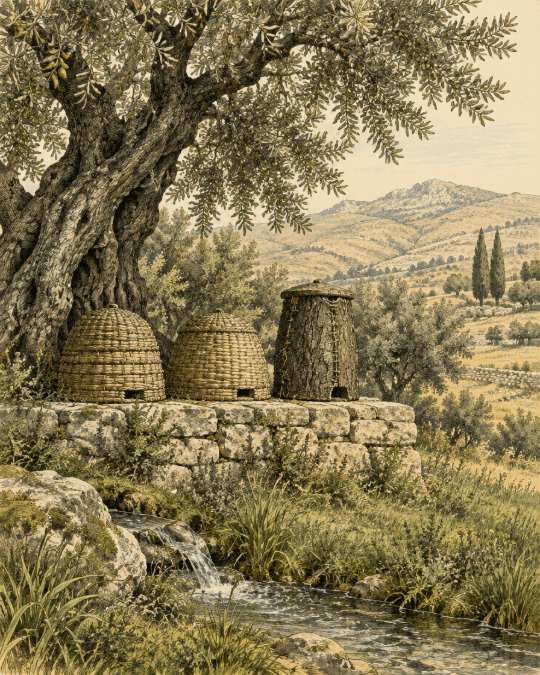
The fourth book of the Georgics, completed around 29 before our era, reads like a manual. Virgil sets the apiary out of the wind, far from the flocks that trample the flowers, clear of lizards and bee eaters, near clear water, under the shade of a palm or a great wild olive. He describes hives stitched from hollowed bark or woven of pliant osier, with narrow entrances, because cold would congeal the honey and heat would make it run. He advises smearing cracked walls with a little smooth mud. He notes that bees sometimes lodge in the hollow of a worm eaten tree.
All of that holds. Two harvests a year, the mouth rinsed with water and trailing smoke held out before opening, a handful of dust thrown to part two swarms at war: the gesture is sound, and the dust works.
Then comes what he is most sure of. Honey, for him, is a dew of heaven which the bees gather ready made. The colony obeys kings, and the weaker of the two is to be killed. Bees know nothing of mating and take up their young from the leaves with their mouths. And a new swarm is manufactured from the beaten carcass of a bullock sealed in a shed, which is what the ancients believed they saw issue from carrion and which was in all likelihood the drone fly, an insect that has borrowed the costume of the bee. The poem is a treatise and an inventory of errors in the same hand, and that is why we keep it.

On 26 August, the house settled that its social channels would stay in English until its workshop for moving images is working.
The decision had been dated otherwise. An earlier calendar switched Instagram and Threads to French on a fixed date, and that date passed without the films being ready. Rather than hold the date and publish insufficient video, the Cabinet coupled the two again: the language will change when the workshop is there, and both will arrive together.
This bulletin does not change. It appears in French and in English, and will continue to.
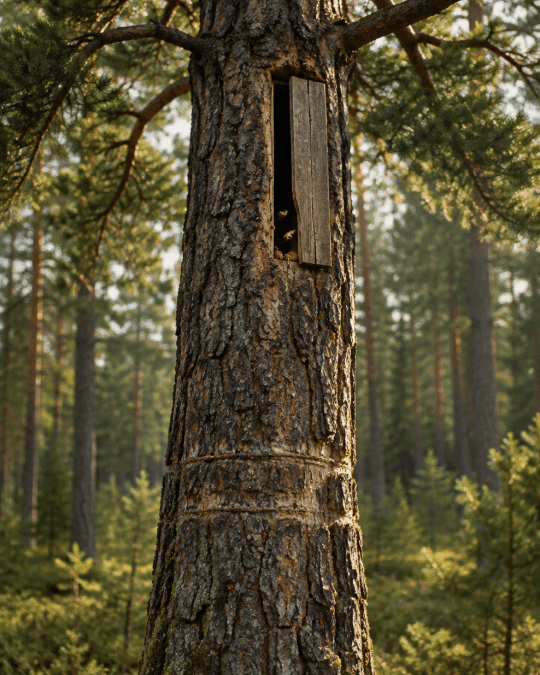
A barć is a living tree in which a cavity has been cut for bees. The Polish word for the practice is bartnictwo, the man who follows it is a bartnik, and the tree goes on growing around the void made in it. That is the point: the cavity imitates the natural hollow where a colony would have settled by itself, a few metres off the ground, in a pine old enough to carry it.
Beside the barć stands the kłoda, a log hollowed from a felled trunk, set near the houses or hung in a tree. UNESCO inscribed the whole in 2020, under the title of tree beekeeping culture, on a joint nomination from Poland and Belarus. The inscription covers both objects, the standing tree and the lying log; it is the barć that requires the living tree.
The practice survives in forests one can name: Kurpie, Augustów, Pilica and Białowieża on the Polish side, Polesia, the country around Hrodna, the Naliboki forest and Belaveja on the Belarusian side. The nomination file describes the intention in a sentence we take as it stands: to recreate the primeval living conditions of the bee, without interfering in its natural cycle. Virgil had noted the hollow of the worm eaten tree. Here it is cut, and the tree stays standing.
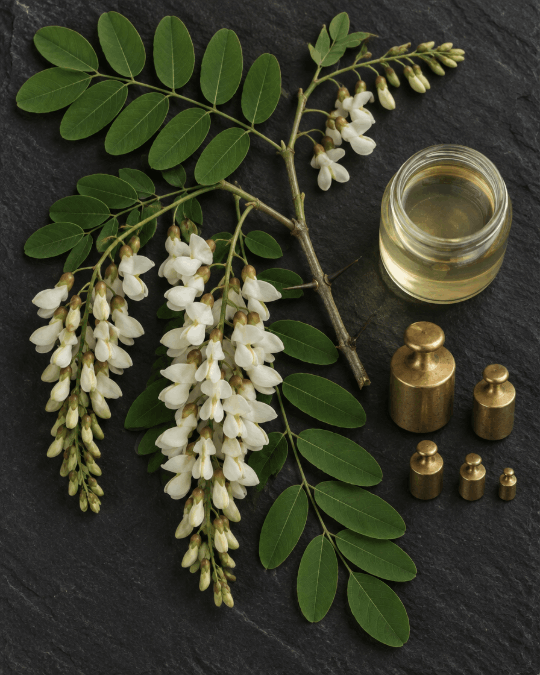
In the first two episodes, a tree from Virginia was planted in Paris in 1601, the genus took the name of the man who had put it in the ground, and the honey went out under another tree's name. What a market does with such a name remained to be seen.
It makes of it, first, a price. In Italy, acacia honey sold in bulk at around seven euros eighty the kilogramme in 2024, when multiflower held at four euros fifty. In Hungary, the records give six euros forty against two euros seventy nine. The name is worth, depending on the year and the country, between one and seven tenths and two and a half times the honey with no name.
It makes of it, next, a category nobody counts. The European customs nomenclature has a single line for honey and distinguishes no variety within it: there is therefore no official statistic of production, of trade or of price for acacia honey, nowhere in the Union. The directive of 2001 permits naming the floral origin if the honey comes wholly or mainly from that source, without saying what mainly means; the text of 2024 that amends it refers that definition to a delegated act expected for 2029. Germany has fixed its own threshold, twenty per cent of black locust pollen, noting in the same paragraph that this pollen is naturally under represented. Serbia asks for twenty per cent as well. The Union asks for nothing.
It makes of it, finally, a protection that is not where one expects it. The only acacia honey with a protected designation of origin of its own is Croatian, the Zagorski bagremov med, registered in 2022. Hungary, which produces the bulk of European acacia honey, holds no Union protection for it; it entered the honey in 2014 in its national hungarikum collection, which has no effect in Union law.
The reference sheet of European unifloral honeys, published in 2004, titles its own black locust honey, and adds that this honey is often incorrectly called acacia honey. The borrowed name is therefore not merely botanically false. It is statistically invisible, and that is what makes it convenient.
Names the cake of wax in which bees store brood, pollen and honey. That rayon has nothing to do with the ray of light. It comes from Frankish *hrâta, by way of Old French ree attested in the twelfth century, which became royon in the fifteenth and rayon in the sixteenth. The ray of light descends from Latin radius through Old French rai, to which the same suffix was added in the same period. Two different stems, one identical suffix, and the two words fall upon the same form in the sixteenth century. The Académie counts a third, the sower's drill furrow, drawn from raie. Littré, writing in the nineteenth century, still filed the light and the shelf under a single entry: the separation is a finding of modern lexicography. For the shelf belongs on this side. The shelf of a library and the aisle of a shop descend from the honeycomb, by way of the tier of planks, and not from the sun.
 The Honey Factories