
“To measure is sometimes to wait two thousand years before learning one was right. This notebook follows what is measured late, or barely at all: the hexagon of the cell, conjectured and then demonstrated two thousand and thirty-four years later; a seasonal note that counts a phenomenon still poorly explained, beneath the lime trees; a toxicity that rests on dosage alone, attested by two witnesses from antiquity; an expansion once feared, then measured and now stabilised; and a word, ruche, which alone measures the distance from Gaulish to French. Four pieces and a word, to take the measure of what resists being measured.”
— The Conservateur
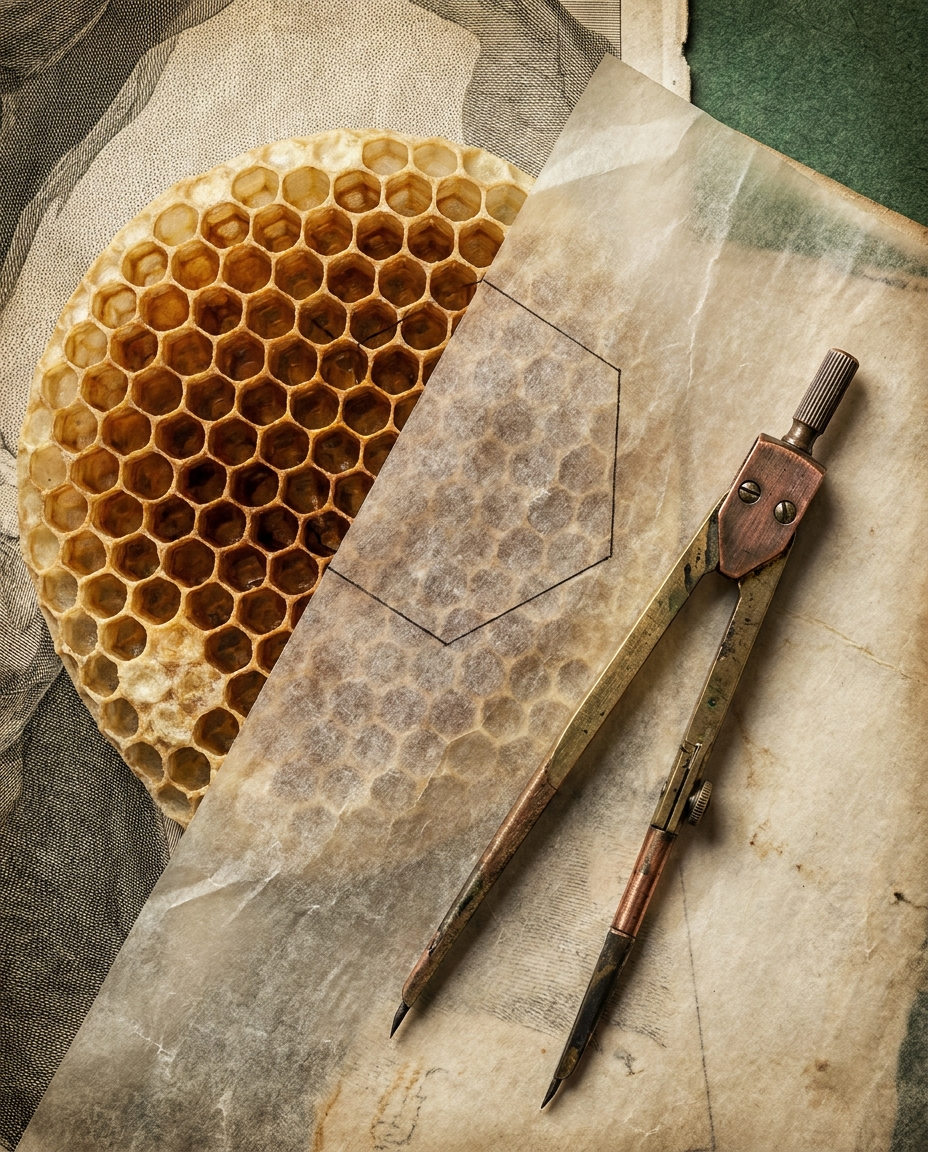
Varro, in De re rustica, put forward in 36 BCE two explanations for the hexagonal shape of the cell: one resting on the bee's six legs, the other on a geometric figure capable of enclosing the greatest area for the same quantity of wax. The second would remain without demonstration for more than two millennia.
The question carries a name, the honeycomb conjecture: among the regular tilings of the plane, the hexagon would minimise total perimeter for equal area, and so the wax required. It passed down the centuries as a plausible hypothesis, never as a theorem.
In June 1999, the mathematician Thomas C. Hales produced the demonstration; his detailed publication appeared in 2001. Between Varro's observation and Hales's proof, two thousand and thirty-four years had passed.
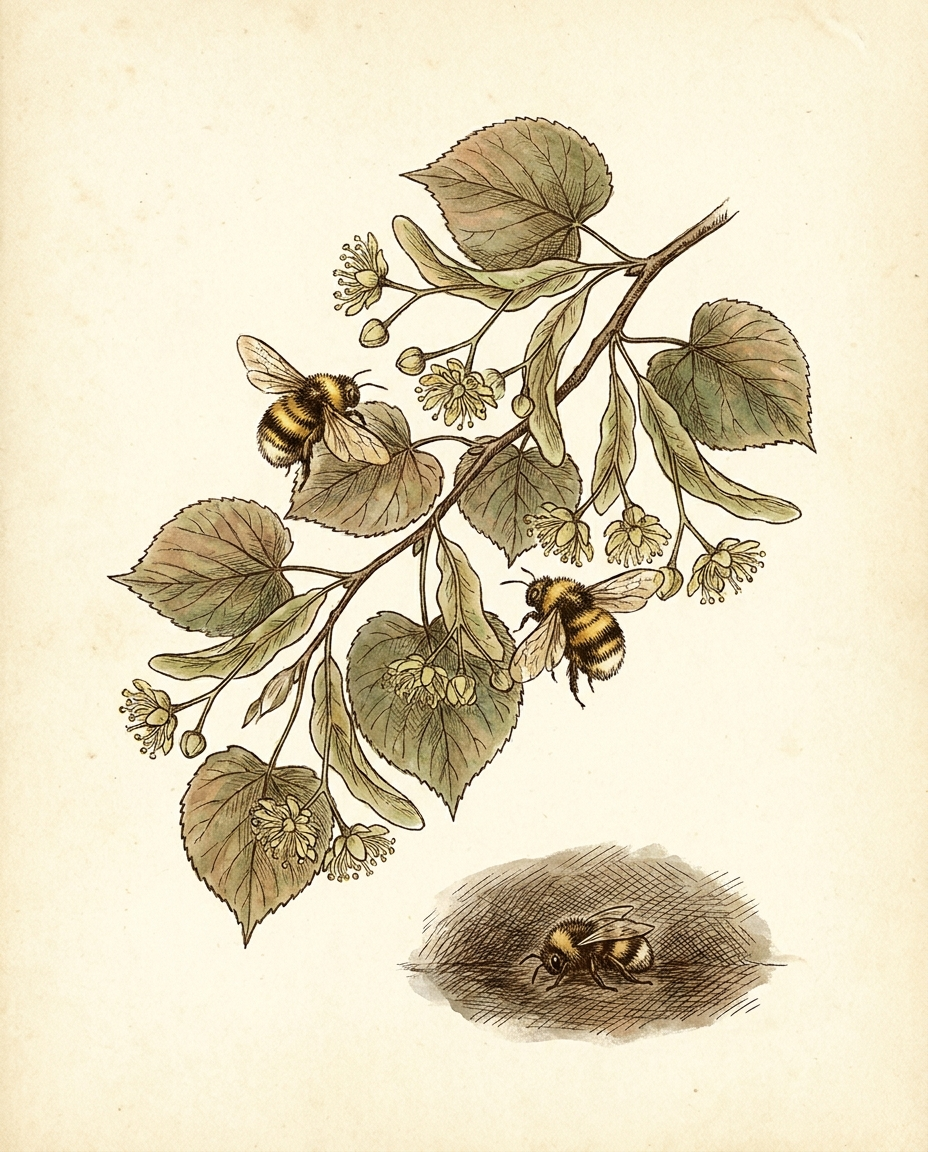
Each year at the same season, inert bumblebees are found at the foot of lime trees, Tilia spp. The phenomenon has been documented for more than a century and was long attributed to mannose, a sugar present in the nectar and held to be indigestible for the insect.
A metabolomic study published in 2019, carried out on the small-leaved lime, Tilia cordata, detected no trace of mannose in the nectar analysed. It found instead the presence of trigonelline, an alkaloid that weakly inhibits acetylcholinesterase, without establishing that this alone accounts for the inertia observed.
The hypothesis now favoured concerns the exhaustion of nectar resources at the end of flowering, which would leave bumblebees without sufficient reserve. It remains a hypothesis: the phenomenon, long documented, is not resolved.
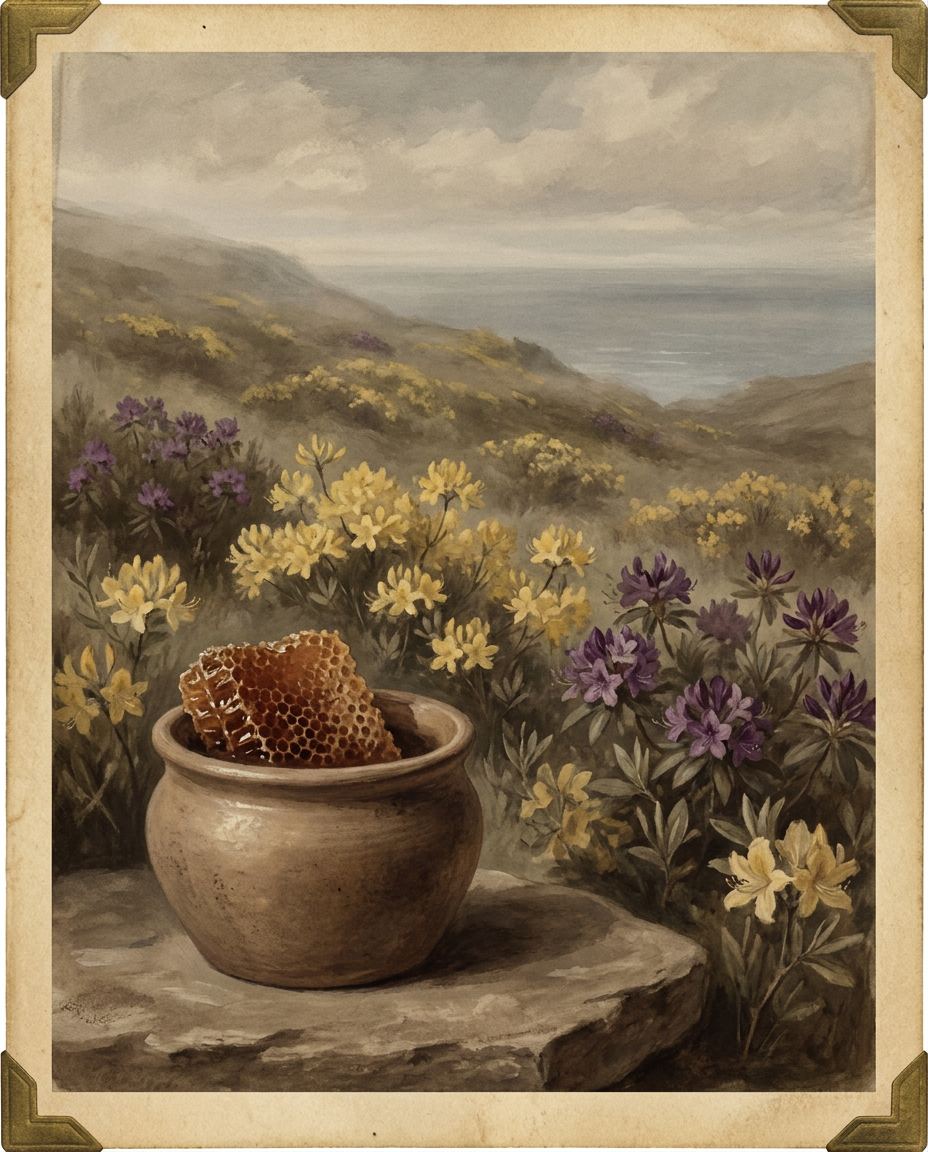
On the Turkish coast of the Black Sea grow Rhododendron ponticum and Rhododendron luteum, rich in grayanotoxin. The honey drawn from them by local bees, reddish and known as deli bal, mad honey, carries its trace.
At very low doses, it is said to have produced a vertigo sought locally; beyond that, sources report nausea, a drop in blood pressure and disorders of heart rhythm. The line between the two rests on dosage alone.
Two ancient witnesses attest to it. Around 401 BCE, Xenophon, in the Anabasis, reports that Greek soldiers approaching Trebizond were poisoned by it, plunged for several days into delirium, though none died. Around 67 BCE, Strabo, in his Geography, Book XII, recounts that the Heptacomitae left combs along the route of Pompey's legions.
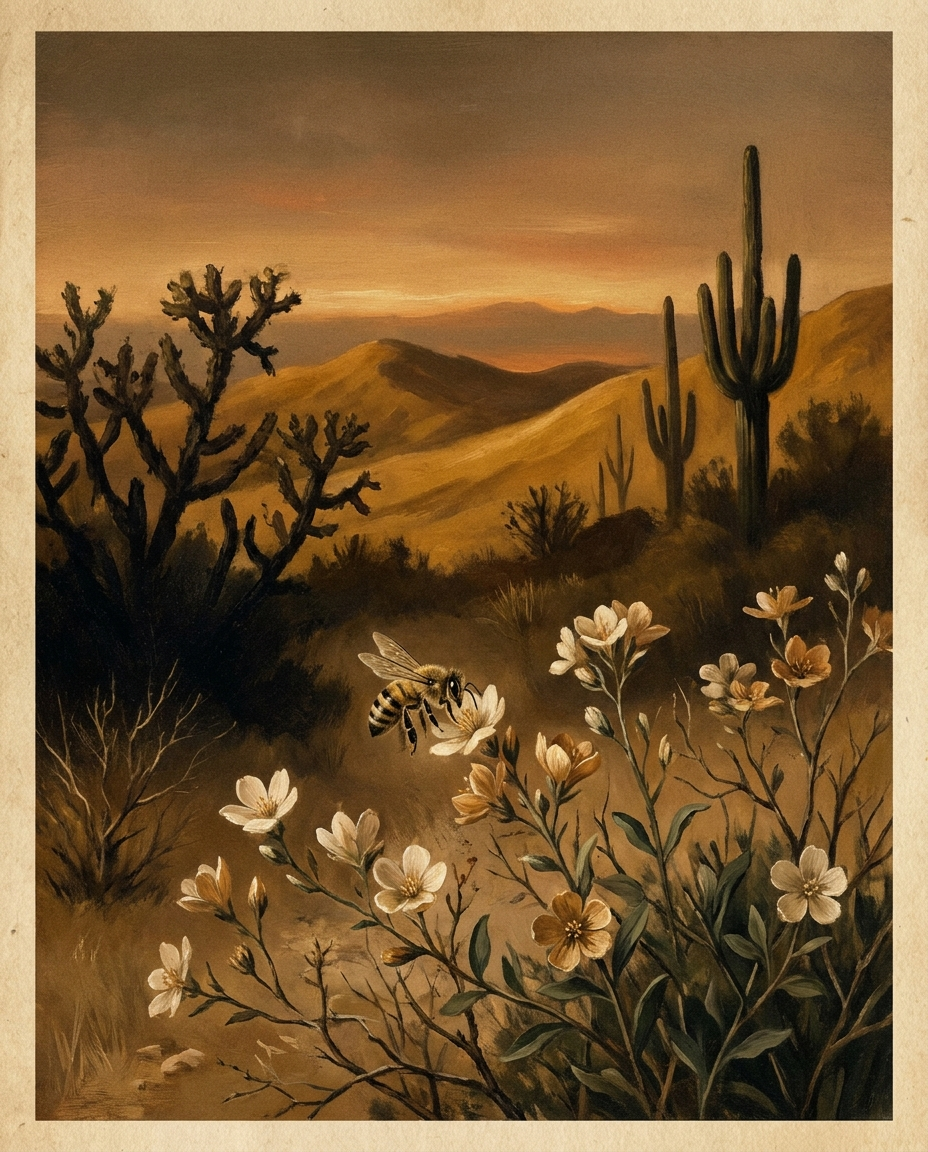
After Kerr, 1956, and the twenty-six swarms that escaped in 1957 (episode I), after Hidalgo, Texas, in October 1990 (episode II), the northward progression of the Africanised bee has markedly slowed against the one hundred and sixty to five hundred kilometres a year observed in tropical zones.
A study published in 2015 in PLOS One recorded African genetic markers in California up to around 38° north latitude, beyond the 34° initially forecast; it describes a moving limit, sensitive to warming. An admixture study published in 2022 in Ecology and Evolution puts the average African ancestry measured in San Diego at around 38 per cent, the proportion recorded in Texas and Arizona running markedly higher.
Deaths attributed to the Africanised bee are recorded unevenly, on the order of fifteen to thirty since 1990 depending on the source; a figure to be set against the 1,109 deaths attributed to hymenoptera stings of all kinds combined, tallied by United States health authorities between 2000 and 2017. The feared expansion has been measured, then stabilised.
One of a small number of French words retained directly from Gaulish without passing through Latin. The word first named the material before it named the container: the earliest hives were sections of bark, before hollowed wood, woven straw and then terracotta took their place. From bark to hive, the word measures the distance separating a material from a built object.
 The Honey Factories